


How Roster Decisions Are Actually Made: What Coaches Will Not Tell You

By Mike Butters | Founder, Hockey Horizons | Hockey Hits

I have been on both sides of the roster table. I have made roster decisions as a general manager and coach at multiple levels of junior hockey. I have also worked with families whose players were cut or not offered spots by organizations that gave them explanations that ranged from incomplete to misleading. What follows is an honest account of how roster decisions in junior hockey are actually made — because families who understand this are in a much better position to navigate it.
The single most important thing to understand about junior hockey roster decisions is that they are made with the organization's needs as the primary consideration, not the player's development needs. A coach who tells a family that their player was not kept because they need another year of development at a lower level may be telling the truth. They may also be telling a polished version of a different truth — that the player they kept instead plays a position the team needed, came with a different financial arrangement, or was personally connected to someone in the organization. All of these reasons are real. None of them are typically communicated honestly.
The second thing to understand is that many roster decisions at the junior level are made before camp even opens. I wrote about this in the context of Main Camps and I will say it again here because it bears repeating: organizations that conduct public tryout camps with significant player fees have often already filled the majority of their roster with returning players, committed recruits, and players connected to the coaching staff. The players attending the public camp are competing for a small number of genuinely open spots — sometimes two or three, sometimes fewer — regardless of how the camp is marketed.
The third thing to understand is that player relationships with coaches matter enormously in junior roster decisions. A coach who has seen a player multiple times, who has a relationship with the player's junior coach, or who has specifically recruited a player is far more likely to roster that player than one who is seeing them for the first time in a camp setting. This is not unfair — it reflects the reality of evaluation. You cannot fully evaluate a player in two days of camp. The players coaches know get the benefit of accumulated observation. The players coaches are seeing for the first time are evaluated cold, which is an inherent disadvantage.
What Families Can Do With This Information
Understanding how roster decisions are made allows families to approach the process more strategically. Build relationships with coaching staffs before camp. Get your player in front of target programs multiple times before you pay a camp fee. Ask specific questions about how many genuine roster openings exist at your player's position before committing to attend any camp. And when a player is not kept, ask for honest feedback — not the diplomatic version, but the specific, actionable version. Coaches who give honest feedback after a cut are genuinely valuable, even when what they say is difficult to hear.
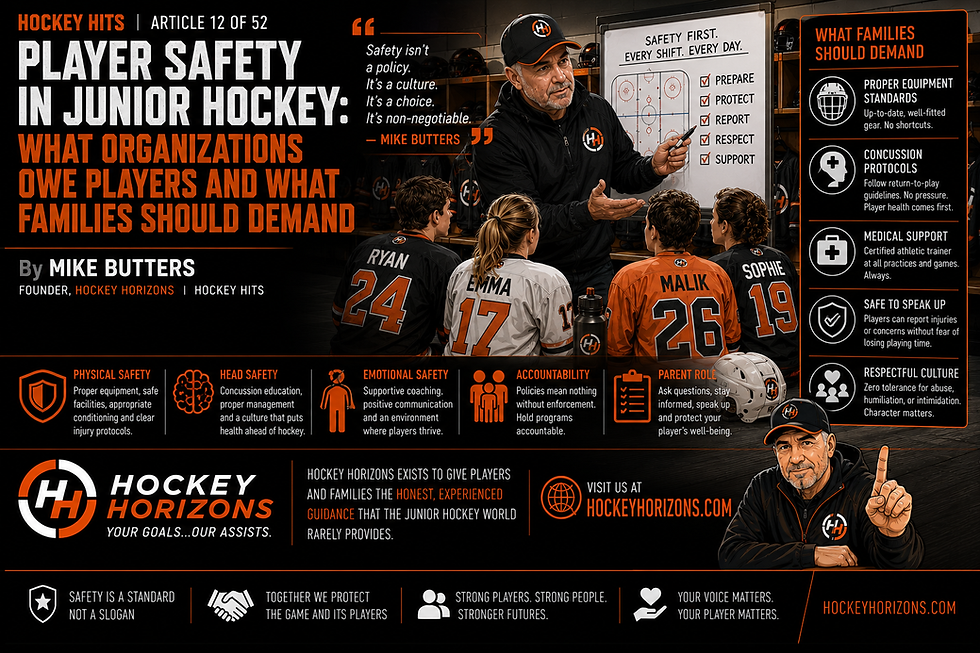
Hockey Horizons exists to give players and families the honest, experienced guidance that the junior hockey world rarely provides. If anything in this article raised questions about your player's situation, reach out. That is exactly what we are here for. Visit us at hockeyhorizons.com.
Hockey Horizons — Your Goals... Our Assists. | hockeyhorizons.com
Hockey Horizons exists to give players and families the honest, experienced guidance that the junior hockey world rarely provides.
For guidance on the complete development picture, visit us at hockeyhorizons.com.


Comments